Life has a way of throwing curveballs when you least expect them. Whether it’s a sudden car repair, an unexpected medical bill, or a temporary lapse in employment, financial surprises are a matter of “when,” not “if.” This is where an emergency fund comes in—a dedicated safety net designed to catch you when life gets bumpy.
However, the traditional advice around saving money can feel incredibly restrictive. We are often told that to build a meaningful savings cushion, we must slash our streaming subscriptions, give up our daily lattes, and adopt a lifestyle of aggressive frugality.
But here is the truth: hyper-restrictive budgeting rarely works long-term. Just like an overly strict crash diet, an extreme savings plan often leads to burnout, frustration, and eventual abandonment.
The good news? You do not have to choose between financial security and enjoying your life. By leveraging smart automation, optimizing hidden expenses, and shifting your financial habits, you can build a robust emergency fund without sacrificing the lifestyle you love.
1. Redefine the Emergency Fund Goal
When you read that a standard emergency fund should cover three to six months of living expenses, the total number can feel overwhelming. If your monthly expenses are $4,000, aiming for a $12,000 to $24,000 goal right out of the gate can make you feel defeated before you even start.
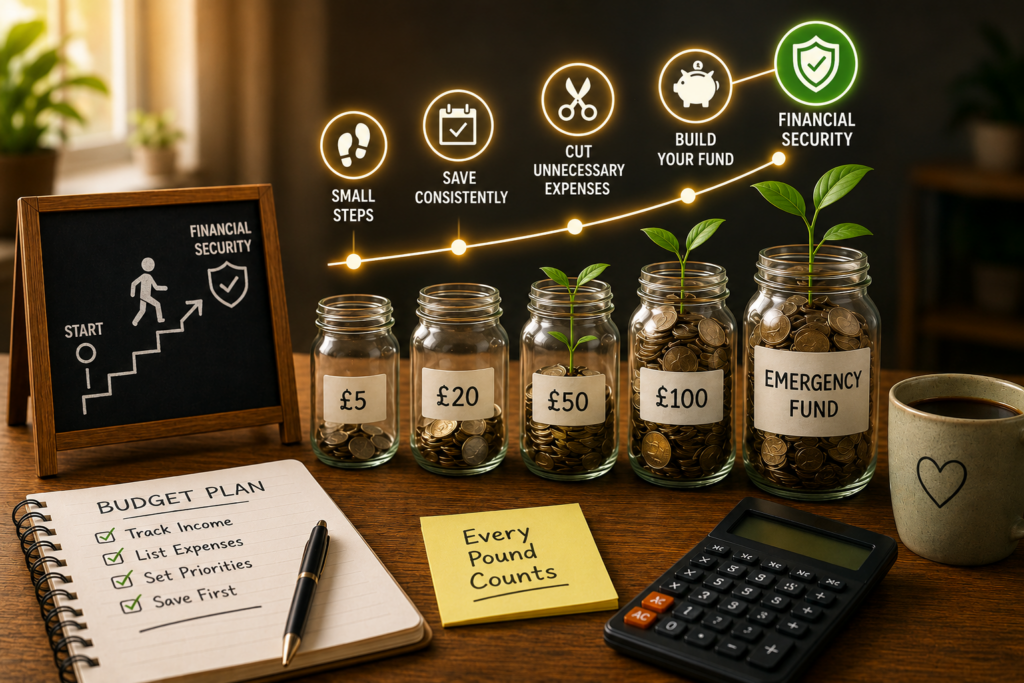
Instead of aiming for the ultimate destination immediately, break your goal down into manageable milestones.
- Milestone 1: The $500 Starter Cushion. This is enough to cover a minor mechanical issue or a broken appliance, keeping you off credit cards for small emergencies.
- Milestone 2: One Month of Bare-Essential Expenses. Not your full lifestyle cost, but what you need to survive (rent/mortgage, basic groceries, utilities).
- Milestone 3: The Three-Month Baseline. A solid foundation that provides genuine peace of mind.
By shifting your focus to smaller, incremental milestones, the process becomes less intimidating, allowing you to build momentum without feeling the urge to drastically alter your daily routine.
2. Leverage “Invisible Savings” via Automation
The biggest secret to saving money without feeling the pinch is to make the process completely invisible. If you wait until the end of the month to save whatever money is “left over,” you will likely find that nothing is left.
Instead, practice the principle of paying yourself first through automation.
The Split-Deposit Strategy
The cleanest way to automate your savings is through your employer’s payroll system. Ask your HR or payroll department to split your direct deposit. Have a small, manageable percentage—say 3% to 5% of your paycheck—automatically routed directly into a separate savings account, while the remaining 95% goes into your standard checking account.
Because that money never hits your main account, your brain won’t register it as available spending money. You naturally adjust your lifestyle to the amount left in your checking account, building your fund completely in the background.
Micro-Savings and Round-Ups
If a flat percentage feels too rigid, utilize financial tools that use micro-savings. Many modern banking apps offer a feature that rounds up every debit card purchase to the nearest dollar and transfers the spare change into a savings account. Spending $4.35 on a coffee means $0.65 automatically slides into your emergency fund. It feels completely insignificant on a daily basis, but over a year, it can quietly compound into hundreds of dollars.
3. Audit Your “Ghost Expenses” (The Zero-Sacrifice Wins)
Before you even think about cutting back on things that bring you joy—like dining out with friends or traveling—look for the financial leaks that add absolutely zero value to your daily life. These are your “ghost expenses.”
| Ghost Expense Type | How to Optimize It | Lifestyle Impact |
| Zombie Subscriptions | Use a subscription tracker to find and cancel apps, gym memberships, or streaming platforms you haven’t used in 30 days. | Zero. You aren’t using them anyway. |
| The “Loyalty Tax” | Call your internet, insurance, and phone providers annually to ask for current promotions, or shop around for a competitor. | Zero. You get the exact same service for less money. |
| Unused Premium Tiers | Downgrade services to a lower tier if you aren’t utilizing the top-level features (e.g., cloud storage, software plans). | Minimal. The core utility remains unchanged. |
Negotiating a $40 reduction on your monthly car insurance and canceling a $15 app subscription you forgot about instantly frees up $55 a month. If you route that directly into your emergency fund, you’ve added $660 to your safety net over a year—without changing a single daily habit.
4. Capitalize on High-Yield Savings Accounts (HYSAs)
Where you store your emergency fund matters just as much as how much you put into it. Traditional brick-and-mortar banks famously offer abysmal interest rates on standard savings accounts, often hovering around a fraction of a percent.
By moving your emergency fund to a reputable online bank offering a High-Yield Savings Account (HYSA), you let your money do some of the heavy lifting for you.
The Power of Compounding Interest: If you store a $5,000 emergency fund in a traditional savings account earning 0.01%, you will make pennies in interest over a year. In a High-Yield Savings Account earning an APY (Annual Percentage Yield) around 4% to 5%, that same $5,000 generates over $200 a year entirely on its own.
That is free money added directly to your financial safety net, requiring absolutely zero effort or lifestyle adjustments on your part.
5. Gamify the Process with “Found Money”
Building savings doesn’t have to feel like a chore; it can be treated like a game. Throughout the year, we frequently encounter small windfalls of “found money”—cash that we weren’t actively expecting or relying on to pay our regular bills.
Commit to a rule where a specific percentage (or 100%) of unexpected windfalls goes straight to your emergency fund:
- Tax Refunds: Instead of spending a tax refund on an impulse purchase, slide half or all of it into your HYSA.
- Work Bonuses or Cash Gifts: Celebrate a little bit with a fraction of it, and use the rest to supercharge your milestones.
- The 52-Week Challenge: Save $1 the first week of the year, $2 the second, $3 the third, and so on. By week 52, you’ll have saved $1,378 incrementally.
Because this money sits entirely outside your normal monthly budget, directing it toward savings feels painless. Your day-to-day lifestyle remains completely untouched, yet your emergency fund grows by leaps and bounds.
Conclusion: Sustainable Financial Security
Building an emergency fund is not about depriving yourself today; it is about protecting your peace of mind tomorrow. When you approach savings through extreme restriction, you build a fragile system prone to failure.
By focusing on incremental milestones, automating your deposits, eliminating invisible financial leaks, and maximizing interest via an HYSA, you treat your savings like a quiet background process. You get to keep your daily routines, your weekend dinners, and your hobbies, all while constructing a financial fortress that ensures an unexpected expense will never turn into a financial crisis.
Start small, automate today, and let time do the rest.