
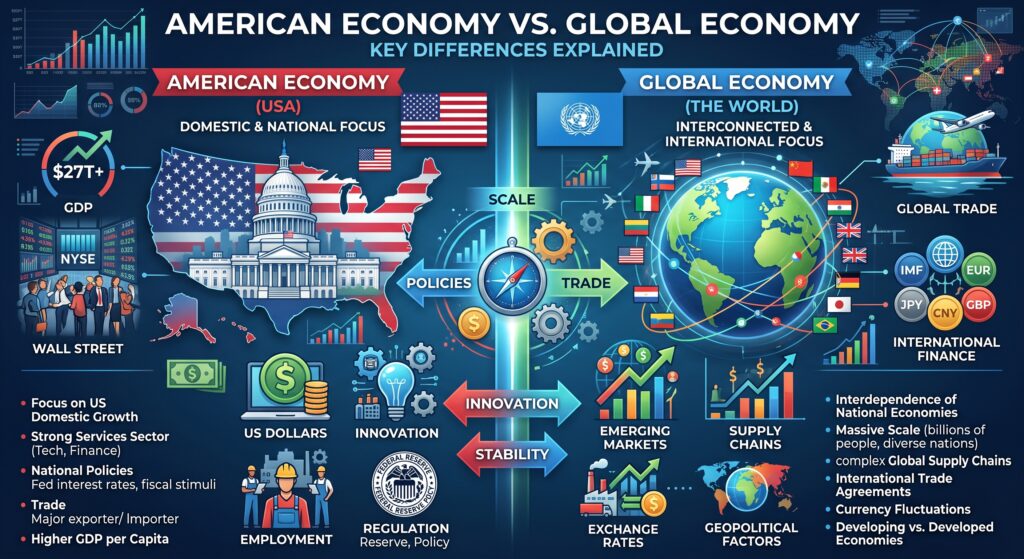
Understanding the structural differences between the United States economy and the global economy is fundamental to navigating international business, financial markets, and global trade. While the U.S. economy serves as a single national entity governed by unified federal policies, the global economy represents an intricate tapestry of nearly 200 distinct national markets.
1. Structure, Scale, and Governance
The fundamental distinction lies in governance, fiscal unity, and economic design.
- Unified vs. Fragmented Governance: The U.S. economy operates under a single monetary authority—the Federal Reserve—and one central fiscal government. In contrast, the global economy lacks a central governing body, relying instead on international institutions like the International Monetary Fund (IMF), World Bank, and World Trade Organization (WTO) to coordinate policy across sovereign nations with competing interests.
- Economic Scale: The U.S. remains the world’s largest national economy by nominal GDP, producing approximately $30 trillion in annual output—accounting for over 25% of the total global economy.
- Market Maturity: The U.S. economy is a advanced, service-oriented market, whereas the global economy combines advanced economies, emerging industrial hubs, and developing markets.
| Economic Dimension | U.S. Economy | Global Economy |
| Gross Domestic Product (GDP) | ~$30 Trillion (Nominal) | ~$110+ Trillion (Nominal) |
| Primary Economic Engine | Consumer Spending (~70% of GDP) | Manufacturing, Trade & Services Balance |
| Monetary Authority | Federal Reserve System | Decentralized (Individual Central Banks) |
| Currency Baseline | U.S. Dollar ($USD) | Multi-currency (USD, EUR, RMB, JPY, etc.) |
2. Key Pillars Driving Economic Growth
Consumer Power vs. Diverse Industrial Drivers
The U.S. economy is uniquely consumer-driven. Personal consumption expenditures account for roughly 70% of total American economic activity, supported by deep credit markets and robust domestic demand.
The global economy, however, depends on a broader mix of growth mechanisms. Regions like East Asia rely heavily on industrial manufacturing and export-oriented growth, while nations in the Middle East and Latin America depend significantly on commodity production and energy exports.
Innovation and Capital Markets
The United States maintains an unmatched ecosystem for technological innovation, venture capital, and deep financial markets. Wall Street represents roughly 40% to 45% of the world’s total stock market capitalization. While global financial centers like London, Tokyo, Frankfurt, and Shanghai are vital, no single international market matches the liquidity and depth of the U.S. financial system.
3. Monetary Policy and Global Currency Dominance
The U.S. Dollar ($USD) holds a unique dual position: it is the domestic currency of the United States and the primary global reserve currency.
- Reserve Currency Status: Over 55% to 60% of foreign exchange reserves held by global central banks are denominated in U.S. Dollars.
- Global Trade Invoicing: International commodities, including crude oil and gold, are predominantly priced and settled in USD worldwide.
- Spillover Effects: Actions taken by the Federal Reserve (such as adjusting interest rates) directly impact borrowing costs, exchange rates, and capital flows across foreign nations, giving U.S. monetary policy an outsized influence on the global economy.
4. Challenges and Economic Risks
While interrelated, the U.S. and global economies face distinct risk profiles:
- U.S. Economic Challenges: Key vulnerabilities include a massive national debt exceeding $34 trillion, persistent wealth inequality, trade deficits, and political friction regarding fiscal policies and tariffs.
- Global Economic Challenges: The worldwide economy faces heightened geopolitical tensions, supply chain fragmentation, currency volatility in emerging markets, and stark disparities in demographic growth—with aging populations in Western Europe and East Asia contrasting with rapidly growing workforces in Africa and South Asia.
The United States functions as both a distinct national economy driven by domestic consumption and the central anchor of the global financial architecture. Understanding this dynamic reveals why economic shifts in Washington and Wall Street inevitably ripple across markets nationwide and around the globe.
To explore how these economic metrics interact across various countries in the Western Hemisphere, check out the analysis in the Americas GDP Comparison Video. This video offers a clear comparative look at nominal GDP trends and rankings across North and South America.