Established by Congress in 1913 through the Federal Reserve Act, the Federal Reserve System—commonly referred to as “the Fed”—serves as the central bank of the United States. Operating as an independent entity within the federal government, the Fed plays a crucial role in maintaining economic stability, managing national monetary policy, and safeguarding the financial infrastructure.
Understanding how the Federal Reserve operates and the mechanisms through which it influences credit, employment, and inflation provides valuable insight into the broader dynamics of the American economy.
1. Structure and Governance of the Fed
The Federal Reserve is designed as a decentralized system that blends public oversight with private-sector operations. This unique structure insulates monetary policy from short-term political pressures while remaining accountable to Congress.
The system comprises three primary entities:
- The Board of Governors: Based in Washington, D.C., this seven-member governmental agency provides overarching leadership. Members are appointed by the President of the United States and confirmed by the Senate to serve staggered 14-year terms.
- The 12 Regional Federal Reserve Banks: Spread across distinct geographic districts (e.g., New York, Chicago, San Francisco), these regional banks monitor local economic conditions, supervise state-chartered member banks, and provide financial services to regional depository institutions.
- The Federal Open Market Committee (FOMC): The principal policymaking body responsible for directing monetary policy. It consists of the seven Board Governors, the president of the Federal Reserve Bank of New York, and four rotating presidents from the remaining eleven Reserve Banks. The FOMC meets eight times a year to evaluate economic conditions and set interest rate targets.
               ┌───────────────────────────────┐
               │      Board of Governors       │
               │  (7 Members / Appointed)      │
               └──────────────┬────────────────┘
                              │
                              ▼
┌─────────────────────────────────────────────────────────────┐
│             Federal Open Market Committee (FOMC)            │
│       Sets monetary policy & Federal Funds Rate targets     │
└──────────────┬───────────────────────────────┬──────────────┘
               │                               │
               ▼                               ▼
┌──────────────────────────────┐┌─────────────────────────────┐
│  12 Regional Reserve Banks   ││  Supervised Banking System  │
│ (Execute policy & research)  ││ (Commercial & Member Banks) │
└──────────────────────────────┘└─────────────────────────────┘
2. The Dual Mandate: Employment and Price Stability
Unlike central banks that focus exclusively on inflation control, the Federal Reserve operates under a statutory Dual Mandate mandated by Congress:
- Maximum Employment: Achieving the highest level of employment that the economy can sustain without causing inflationary overheating.
- Stable Prices: Maintaining a low, predictable rate of inflation—officially targeted at 2% per year over the long run.
Balancing these two objectives creates an ongoing trade-off. When the economy slows and unemployment rises, the Fed typically eases policy to stimulate growth. Conversely, when rapid economic expansion drives inflation above acceptable thresholds, the Fed tightens policy to cool aggregate demand.
3. How Monetary Policy Works
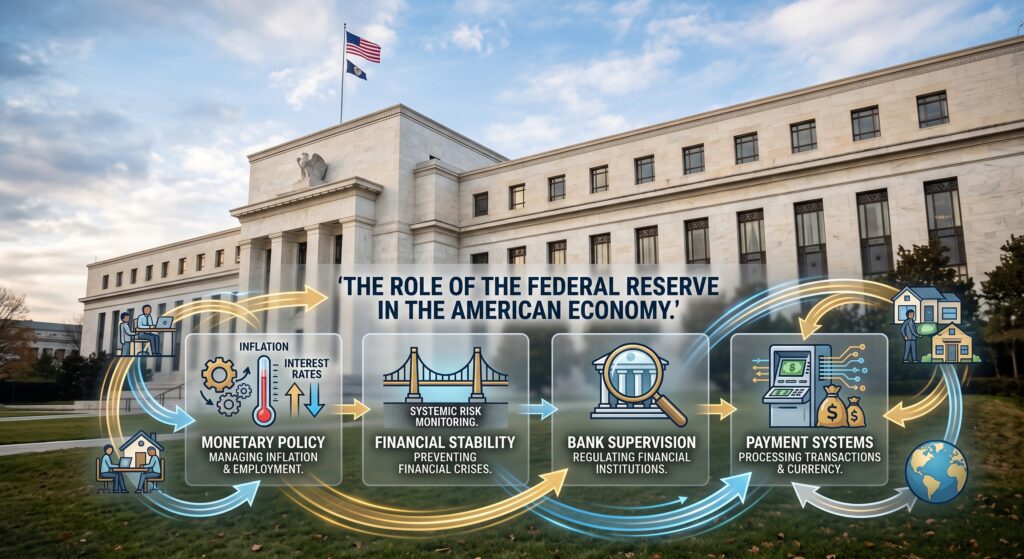
The Federal Reserve directs the economy primarily by influencing short-term interest rates and the overall availability of liquidity within the financial system.
The Federal Funds Rate
The primary lever of monetary policy is the Federal Funds Rate (FFR)—the interest rate commercial banks charge one another for overnight, uncollateralized loans of excess reserves. While the Fed does not set this rate directly by decree, it establishes a target range and uses specialized policy tools to keep market rates within that band.
| Policy Stance | Fed Action | Economic Mechanism | Primary Goal |
| Expansionary (Dovish) | Lowers benchmark interest rates | Reduces borrowing costs across consumer and business loans | Stimulate investment, hiring, and consumer spending |
| Contractionary (Hawkish) | Raises benchmark interest rates | Increases credit costs, slowing consumer demand and capital expenditure | Curb elevated inflation and prevent overheating |
Modern Policy Tools
To maintain control over money supply and interest rates, the Fed employs several complementary tools:
- Open Market Operations (OMOs): Buying or selling U.S. Treasury securities on the open market to adjust bank reserves.
- Interest on Reserve Balances (IORB): The rate paid to commercial banks for keeping funds in their accounts at the Fed, setting a natural floor under short-term market rates.
- Overnight Reverse Repurchase Agreements (ON RRP): A facility that absorbs excess market liquidity by offering money market funds and non-bank financial entities a risk-free yield, reinforcing the lower bound of the target range.
- The Discount Window: A standing facility where eligible institutions can borrow directly from the Fed on a short-term basis to meet immediate liquidity shortages.
4. Financial Supervision and Regulation
Beyond monetary policy, the Federal Reserve serves as a key regulator of financial institutions. In cooperation with agency partners like the Federal Deposit Insurance Corporation (FDIC) and the Office of the Comptroller of the Currency (OCC), the Fed oversees bank holding companies, large international banking firms, and state-chartered banks that belong to the system.
In this role, the Fed conducts annual stress tests on major financial institutions to evaluate whether they maintain adequate capital buffers to withstand severe macroeconomic downturns.
Furthermore, as the Lender of Last Resort, the Federal Reserve steps in during acute financial shocks to supply emergency liquidity. This prevents contagious bank runs and stabilizes systemically important credit markets during panics.
5. Payments, Currency, and Fiscal Operations
The Fed provides critical operational services that keep the day-to-day economy running smoothly:
- Currency Distribution: It works alongside the U.S. Treasury’s Bureau of Engraving and Printing and the Bureau of the Mint to manage physical paper money and coins, distributing cash to commercial banks according to demand.
- Clearing Payment Systems: The Fed operates electronic clearing and settlement networks—such as Fedwire, the Automated Clearing House (ACH) network, and FedNow—ensuring trillions of dollars in interbank transfers, direct deposits, and retail payments move securely every day.
- Fiscal Agent for the U.S. Government: The Fed maintains the checking account of the U.S. Department of the Treasury, processes federal tax receipts, handles debt issuance, and clears government payments.
6. How Fed Decisions Touch Everyday Life
While the Fed operates at an institutional level, its policy decisions filter through every corner of main street commerce.
When the FOMC alters the policy rate, the effect cascades through the yield curve:
- Mortgage Rates: Fixed and adjustable mortgage rates fluctuate based on benchmark treasury yields and broader rate expectations, directly impacting housing affordability.
- Consumer Credit: Rates on auto loans, personal credit lines, and credit cards adjust alongside changes in the prime rate, influencing consumer borrowing power.
- Business Capital Allocation: Higher interest rates raise the hurdle rate for corporations considering new projects, machinery purchases, or workforce expansions.
- Savings Rates: Higher policy rates provide depositors with better yields on High-Yield Savings Accounts (HYSAs) and Certificates of Deposit (CDs).
Conclusion
The Federal Reserve occupies a central role in guiding the health of the U.S. economy. By managing monetary policy to foster low inflation and maximum employment, acting as a vigilant bank supervisor, and supporting the national payments grid, the Fed helps ensure economic stability amidst changing global financial dynamics. Although its policies frequently spark economic debate, its role as a stabilizing force remains vital to sustained macroeconomic growth.