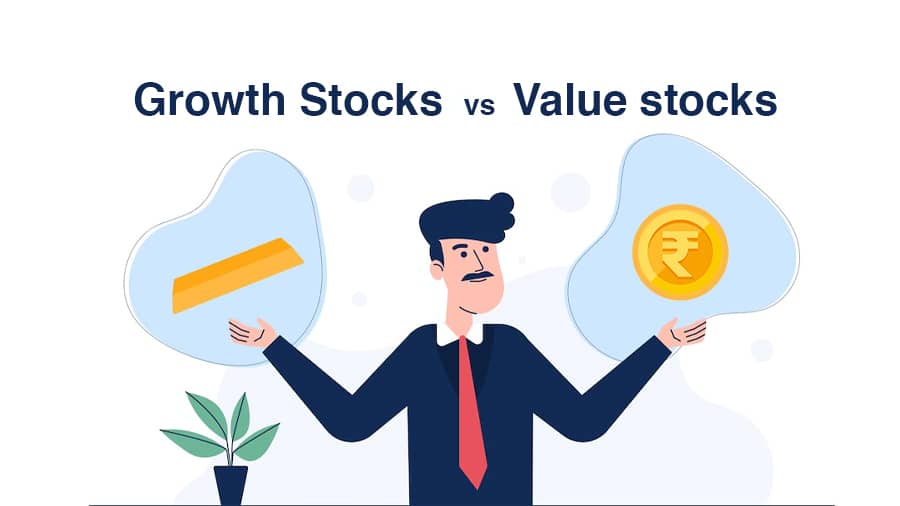
In the world of investing, few debates are as enduring or as spirited as the choice between Growth and Value stocks. It’s the financial equivalent of the “tortoise and the hare” fable, though in the stock market, the winner often depends on when you start the clock.
For investors aiming to build long-term wealth, understanding these two philosophies is essential. Whether you are a seasoned trader or just starting your portfolio, the choice between growth and value will define your risk profile, your potential returns, and your peace of mind during market volatility.
Understanding the Core Philosophies
Before deciding which is “better,” we must define what each style represents. While both aim for the same goal—profit—they take radically different paths to get there.
1. Growth Stocks: The Visionaries
Growth stocks are companies that are expected to grow sales and earnings at a faster rate than the market average. These companies usually possess a unique product, a dominant market position, or a revolutionary technology.
- Characteristics: High Price-to-Earnings (P/E) ratios, little to no dividends, and high volatility.
- The “Why”: Investors buy growth stocks because they believe the company’s future potential justifies a premium price today.
- Examples: Think of tech giants like Nvidia or SaaS companies that reinvest every penny into R&D and expansion.
2. Value Stocks: The Bargain Finds
Value stocks are companies that are currently trading at a price lower than what their fundamentals (earnings, sales, and assets) suggest they are worth. They are essentially “on sale.”
- Characteristics: Low P/E ratios, high dividend yields, and stable business models.
- The “Why”: Value investors, inspired by the likes of Benjamin Graham and Warren Buffett, look for “intrinsic value” that the market has temporarily overlooked due to bad news or industry cyclicality.
- Examples: Established banks, energy companies, or retail staples like Coca-Cola.
The Performance Pendulum: A Historical Context
If you look at the last decade (roughly 2010–2021), Growth was the undisputed champion. Low interest rates allowed growth-oriented tech companies to borrow cheaply and scale aggressively. However, history shows that these styles move in cycles.
- When Growth Leads: Typically during periods of low interest rates and economic expansion. When money is “cheap,” investors are willing to pay more for future earnings.
- When Value Leads: Usually during economic recoveries, periods of high inflation, or when interest rates rise. As rates go up, the “present value” of future cash flows drops, making immediate profits and dividends from value stocks more attractive.
Key Metrics for Comparison
To determine where a stock falls, investors use several fundamental ratios.
| Metric | Growth Stocks | Value Stocks |
| P/E Ratio | High (often >30x) | Low (often <15x) |
| Price-to-Book (P/B) | High | Low |
| Dividend Yield | Rare/Low | Common/Higher |
| Earnings Volatility | High | Stable |
Risk vs. Reward: The Trade-Off
Choosing between these two isn’t just about the numbers; it’s about your psychological appetite for risk.
The Risk of Growth
The biggest danger in growth investing is valuation risk. If a company priced for perfection misses an earnings report by even a small margin, the stock price can crater. You are betting on a future that hasn’t happened yet.
The Risk of Value
Value investors face the “Value Trap.” This happens when a stock looks cheap, but it’s cheap for a reason—perhaps its industry is dying, its management is poor, or it has lost its competitive edge. A stock that is “on sale” can still go to zero.
The Impact of the Economic Environment
The macroeconomy plays a massive role in which style performs better.
- Interest Rates: As mentioned, growth stocks are sensitive to rate hikes. When the Federal Reserve raises rates, the discounted cash flow (DCF) models used to value growth companies result in lower stock prices.
- Inflation: Value stocks, particularly in energy and materials, often act as a hedge against inflation because they represent “hard” assets and immediate cash flow.
- Market Sentiment: Growth thrives on optimism and “FOMO” (Fear Of Missing Out). Value thrives on pragmatism and “Margin of Safety.”
The Hybrid Approach: Growth At A Reasonable Price (GARP)
Many modern investors find the binary choice too limiting. This has led to the rise of GARP (Growth At A Reasonable Price). GARP investors look for companies with solid growth potential but avoid those with astronomical valuations. It’s a middle ground that seeks the best of both worlds—steady expansion without the “bubble” risk.
Which Is “Better” for You?
The answer to “which is better” depends entirely on your personal financial situation:
- Choose Growth if: You have a long time horizon (10+ years), high risk tolerance, and don’t need immediate income from your portfolio.
- Choose Value if: You are closer to retirement, prefer steady dividends, and want to minimize the chance of seeing 30% swings in your portfolio value overnight.
Conclusion: The Power of Diversification
In the long run, the most successful portfolios rarely bet exclusively on one horse. A diversified approach—holding both growth and value—ensures that you have exposure to the “hares” when the market is sprinting and the “tortoises” when the market gets bumpy.
Instead of asking which is better, ask how much of each you need to reach your goals. By balancing the explosive potential of growth with the grounded stability of value, you create a resilient strategy capable of weathering any economic season.
Would you like me to analyze a specific sector (like Tech or Energy) to see if it currently leans more toward Growth or Value?