
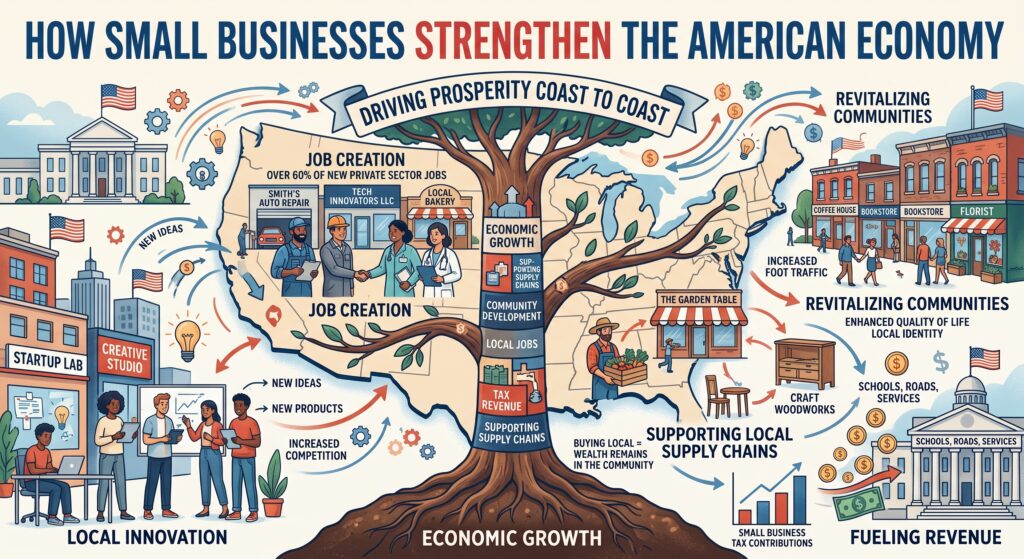
When picturing the engines driving the United States economy, massive multinational corporations and Silicon Valley tech giants often capture the headlines. Yet, beneath the shadow of Wall Street sits the true engine of American prosperity: small businesses. From main street retail shops and neighborhood diners to emerging technology startups and local service providers, small enterprises form the core structure of the U.S. economic ecosystem.
According to the U.S. Small Business Administration (SBA), small businesses account for 99.9% of all U.S. firms and employ nearly half of the private-sector workforce. Beyond these striking numbers lies a deeper story: small businesses create jobs, foster community stability, spark innovation, and generate local wealth.
The Backbone of Job Creation and Employment Stability
One of the most direct contributions small businesses make to the economy is employment generation. Between 1995 and 2021, small businesses created roughly 62% of net new jobs in the United States.
┌─────────────────────────────────────────────────────────┐
│              U.S. Private Sector Landscape              │
├───────────────────────────────┬─────────────────────────┤
│  Small Business Share         │  99.9% of all U.S. firms │
├───────────────────────────────┼─────────────────────────┤
│  Private Workforce Share      │  ~46.4% of U.S. workers │
├───────────────────────────────┼─────────────────────────┤
│  Net New Jobs Created (20 yrs)│  Over 60% of total jobs │
└───────────────────────────────┴─────────────────────────┘
This ongoing hiring capacity provides critical resilience during economic downturns. While large corporations often execute widespread layoffs during recessions to satisfy short-term shareholder expectations, small business owners generally have deeper personal ties to their employees and local communities. As a result, they frequently attempt to retain staff through challenging market cycles.
Additionally, small businesses serve as an essential entry point into the labor market. They offer crucial first-job opportunities for young adults, second-chance employment, and flexible arrangements for parents and retirees. By providing accessible pathways to entry-level roles, small enterprises help build workforce skills, lower regional unemployment, and increase overall labor force participation.
Local Wealth Generation and the Multiplier Effect
When a consumer spends a dollar at a national big-box chain, a significant portion of that revenue leaves the immediate community to cover corporate overhead, executive salaries, and shareholder dividends. In contrast, spending at a locally owned small business triggers what economists call the local economic multiplier effect.
Local businesses recirculate a far higher percentage of their revenue back into the local economy:
- Local Sourcing: Small businesses frequently hire local service providers, such as accountants, print shops, contractors, and legal firms.
- Local Payroll: Employees of small businesses generally live nearby and spend their paychecks on local housing, groceries, and entertainment.
- Community Reinvestment: Independent business owners are substantially more likely to sponsor local sports teams, donate to area non-profits, and support neighborhood civic events.
Research indicates that for every $100 spent at an independent local business, approximately $68 remains in the local economy, compared to less than $43 spent at a national chain. This localized wealth creation strengthens tax bases, funding public infrastructure, emergency services, and local school systems without requiring massive state subsidies.
Drivers of Innovation and Agility
While large corporations hold vast financial resources for research and development, their size often introduces bureaucratic inertia. Small businesses, unencumbered by complex corporate layers, operate with notable agility and adaptability.
Small firms produce 16 times more patents per employee than large patenting universities or major corporate entities. They frequently originate in response to unaddressed market gaps or specific local problems.
“Small businesses do not merely adapt to market trends—they actively invent them by solving niche problems that corporate giants overlook.”
   ┌──────────────────────┐         ┌──────────────────────┐
   │  Large Corporations  │         │   Small Businesses   │
   ├──────────────────────┤         ├──────────────────────┤
   │ High Capital Base    │         │ High Agility         │
   │ Slow Decision Cycles │   vs.   │ Rapid Prototyping    │
   │ Incremental Updates  │         │ Disruptive Ideas     │
   └──────────────────────┘         └──────────────────────┘
When market conditions shift rapidly—such as during supply chain disruptions or global health crises—small businesses pivot faster. They adopt new technologies, alter product lines, and adjust business strategies overnight, injecting dynamic energy into the broader market.
Fostering Diversity, Equity, and Wealth Building
Entrepreneurship remains one of the most reliable vehicles for personal wealth accumulation and social mobility in America. Owning a business allows individuals from historically underrepresented backgrounds to build long-term equity, create generational wealth, and achieve financial independence.
In recent years, the profile of American entrepreneurship has diversified rapidly:
- Women-Owned Businesses: Represent over 39% of all U.S. businesses, generating trillions in annual revenue.
- Minority Entrepreneurship: Black, Hispanic, and Asian-American entrepreneurs represent the fastest-growing segment of new business applications across the nation.
- Veteran-Owned Enterprises: Military veterans apply leadership experience to operate over 300,000 businesses across industrial, tech, and retail sectors.
By lowering barriers to entry, small business ownership provides marginalized communities with direct routes to financial growth, reducing systemic income inequality and strengthening regional economic stability.
Enhancing Supply Chain Resilience and Regional Identity
Modern economic challenges have exposed the vulnerabilities of overly centralized global supply chains. Small domestic manufacturers, logistics providers, and regional distributors provide crucial redundancy and resilience. When global shipping corridors face delays, local supply chains help bridge supply shortages across essential goods and services.
Beyond supply chain durability, small businesses define the cultural identity and character of American neighborhoods. A unique main street lined with distinct shops, historic diners, and artisanal workshops creates a sense of place. This distinct identity attracts tourism, raises residential property values, and invites long-term real estate investment.
Policy Implications for Sustainable Economic Growth
Because small businesses deliver substantial public value, sustaining them requires intentional economic policy and support structures. Key priority areas include:
- Access to Capital: Expanding micro-lending programs, SBA-backed loans, and community development financial institutions (CDFIs) to ensure equitable funding access.
- Regulatory Simplification: Reducing unnecessary compliance paperwork that disproportionately impacts small operations lacking specialized legal teams.
- Healthcare Affordability: Lowering healthcare costs so small employers can offer competitive benefit packages against larger corporate entities.
- Digital Transition Assistance: Equipping traditional main-street businesses with e-commerce, cybersecurity, and digital marketing capabilities.
Conclusion
Small businesses are far more than a charming feature of American main streets—they are fundamental engines of macroeconomic strength, innovation, and social stability. By creating millions of durable jobs, keeping capital circulating locally, driving technological breakthroughs, and offering accessible paths to financial independence, small enterprises sustain the foundation of the American economy.
Supporting small businesses through informed policy choices, community investment, and everyday consumer habits is an investment in the long-term prosperity, resilience, and vitality of the entire nation.