
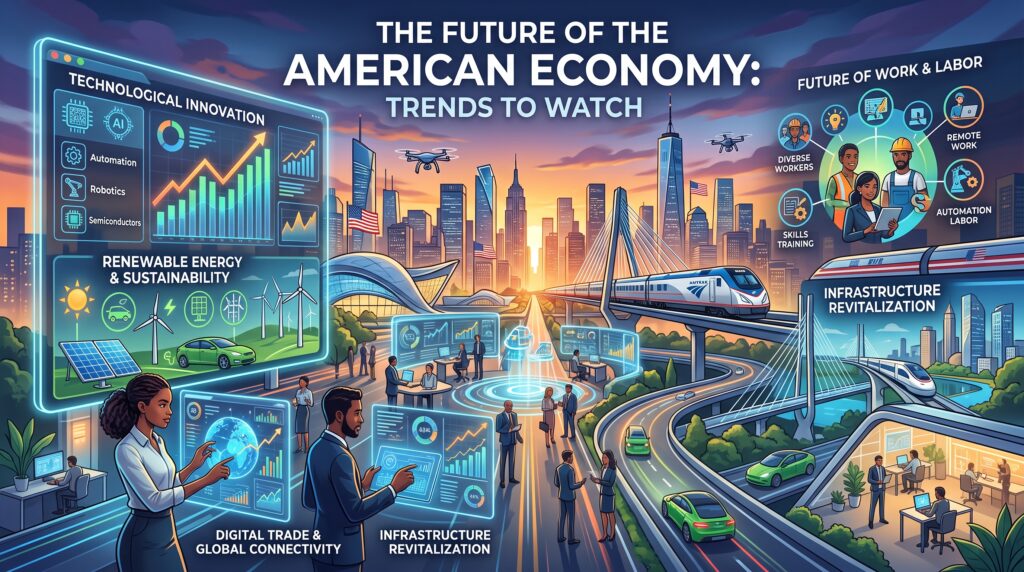
The United States economy stands at a pivotal structural turning point. Moving beyond post-pandemic normalization, the macroeconomic climate is being defined by rapid technological breakthroughs, shifts in monetary policy, evolving labor dynamics, and restructuring global supply chains. Understanding these structural shifts is essential for business leaders, investors, and policymakers navigating the next decade of American commerce.
1. Capital Expenditure and the AI Revolution
Artificial intelligence has transitioned from speculative tech venture to a primary macro-economic driver. Capital expenditure (CapEx) in data centers, high-performance semiconductor design, and cloud infrastructure now accounts for a significant portion of domestic growth.
The immediate beneficiary is the physical technology stack—hardware manufacturing, specialized real estate, and utility providers supplying the massive energy demands of modern compute power. Over the longer term, productivity gains are expected to diffuse across traditional sectors, including healthcare, financial services, logistics, and legal operations.
- Productivity Gains: Automation of routine tasks allows white-collar knowledge workers to shift focus toward high-value analysis and strategic output.
- Energy Demand: Advanced computing requires substantial grid updates, driving massive investment into domestic energy infrastructure.
- Enterprise Integration: Non-tech companies are scaling back generic software budgets to reallocate funds toward proprietary AI agents and workflow integration.
2. Labor Market Realignment: The “Low-Hire, Low-Fire” Paradigm
The U.S. labor market has stabilized into an asymmetric pattern characterized by low layoffs alongside moderated hiring rates. While headline unemployment remains near historical norms, job creation has narrowed toward targeted industries.
                                  +---------------------------------------+
                                  |   AI & Automation Adoption           |
                                  +-------------------+-------------------+
                                                      |
                                                      v
      +-----------------------------------------------+-----------------------------------------------+
      |                                                                                               |
      v                                                                                               v
+-----------------------------------------------+                               +-----------------------------------------------+
| Higher Demand Sectors                         |                               | Moderating Demand Sectors                     |
| - Specialized Engineering & Cybersecurity    |                               | - Entry-level Administrative Support          |
| - Healthcare & Elder Care                     |                               | - Generalist Knowledge Roles                  |
| - Energy & Infrastructure Tech                |                               | - Basic Customer Support Operations           |
+-----------------------------------------------+                               +-----------------------------------------------+
The transformation in labor dynamics focuses on skill requirements rather than raw headcount. Specialized technical roles, healthcare services, and renewable infrastructure engineering see structural shortages, whereas generalist knowledge workers face increased competition and longer job-search durations.
3. Monetary Policy and Fiscal Realities
The Federal Reserve continues its delicate balancing act, steering monetary policy between curbing sticky service inflation and maintaining maximum employment.
- Higher Neutral Rates: Interest rates are expected to settle at a higher structural baseline than the sub-zero or near-zero rates of the 2010s, ending the era of hyper-cheap capital.
- Fiscal Pressure: Rising federal debt servicing costs limit traditional fiscal stimulus measures, forcing lawmakers to prioritize targeted industrial policy over broad-based fiscal expansion.
- Commercial Real Estate (CRE) Refinancing: Maturing debt in the CRE sector—particularly office assets—continues to undergo a multi-year restructuring process as regional banks adjust balance sheets to realistic property valuations.
4. Supply Chain Regionalization and Industrial Policy
Global supply chains are being permanently reconfigured around geopolitical risk mitigation, energy security, and supply continuity. The long-standing focus on absolute cost minimization has given way to resilience, bringing significant industrial activity back to North America.
| Strategy Dimension | Traditional Globalization Era | Emerging Regionalization Era |
| Primary Goal | Operational cost reduction | Supply resilience & security |
| Manufacturing Hubs | Concentrated overseas networks | Onshoring, nearshoring (Mexico/Canada) |
| Inventory Model | Just-In-Time (JIT) delivery | Just-In-Case (JIC) buffer stocks |
| Policy Driver | Free-trade market integration | Targeted industrial incentives & domestic subsidies |
Policies encouraging domestic semiconductor manufacturing, clean tech production, and defense technology have revitalized factory construction in the American Sunbelt and Midwest. While nearshoring lowers supply disruption risks, it introduces structural cost floors that companies must absorb or pass along through pricing strategies.
5. Consumer Financial Divergence and Household Budgets
The American consumer accounts for roughly 70% of U.S. GDP, making household financial health the ultimate economic indicator. Recent years have revealed a growing divide in household financial capacity.
High-income households—benefiting from equity appreciation, home equity gains, and elevated yields on cash holdings—continue to drive consumer spending in luxury, travel, and wealth management services. Conversely, low-to-middle-income consumers face lingering pressures from cumulative inflation in essential categories like housing, vehicle insurance, healthcare, and utilities.
This financial divergence has shifted retailer strategy, with value brands gaining market share while premium experience sectors remain surprisingly robust.
Navigating the Horizon
The future of the American economy is neither defined by pure boom nor systemic crisis; rather, it is undergoing a comprehensive structural reorganization. Organizations that adjust capital allocation to higher baseline interest rates, invest intelligently in technology integration, and build resilient, localized supply networks will be best positioned for durable growth in the years ahead.