
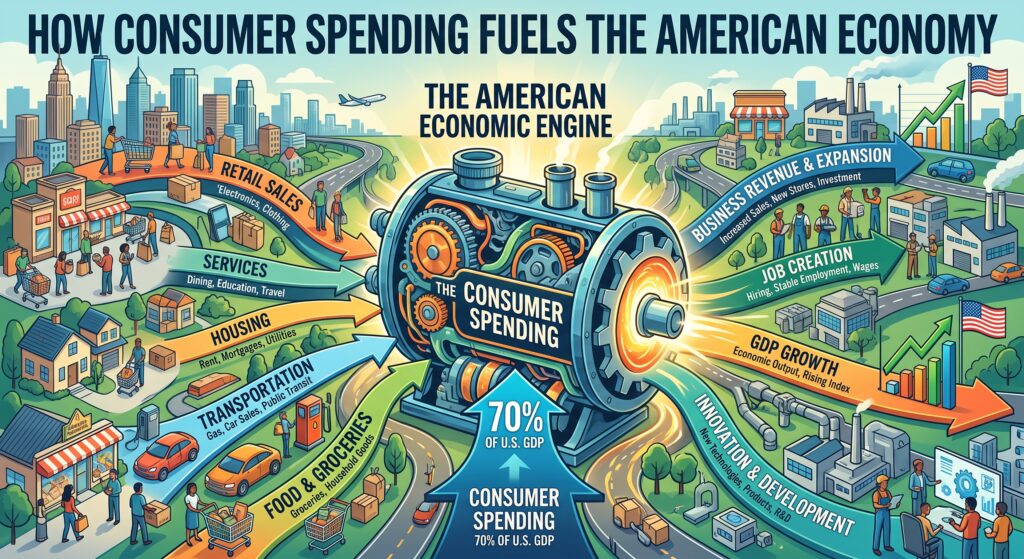
Personal consumption expenditures (PCE) account for roughly 68% of the United States Gross Domestic Product (GDP), making household demand the single largest engine driving American macroeconomic growth. From daily groceries and streaming subscriptions to vehicle purchases and healthcare services, individual spending choices propagate through broader supply chains, directly determining corporate revenue, employment levels, and long-term capital investment.
The Core Breakdown: Consumption within U.S. GDP
To evaluate how individual purchases drive the overall economy, macroeconomists measure total national output through the standard expenditure formula:
Where:
- (Consumption): Personal consumption expenditures by households and non-profit institutions.
- (Investment): Private business investments, equipment acquisitions, residential housing construction, and corporate inventory changes.
- (Government): Federal, state, and local government spending on defense, infrastructure, public services, and administration.
- (Net Exports): Total exports minus total imports.
While business investment and government expenditures fluctuate alongside credit cycles and political policy, private consumption ($C$) serves as the steady foundational anchor of American output.
| GDP Component | Share of U.S. Economy | Macroeconomic Function |
| Personal Consumption ($C$) | ~67% – 69% | Primary engine of domestic market activity, sales revenue, and labor demand. |
| Private Investment ($I$) | ~16% – 18% | Expands future production capacity, technology innovation, and structural assets. |
| Government Spending ($G$) | ~17% – 19% | Finances public goods, national defense, infrastructure, and social safety nets. |
| Net Exports ($NX$) | -2% to -4% (Trade Deficit) | Net domestic purchases fulfilled by imported goods and services. |
Categorizing Household Expenditures: Goods vs. Services
The U.S. economy has evolved into a services-dominant system. Personal consumption is divided into three distinct operational buckets:
- Services (~65% of total spending): Housing rent and utilities, healthcare, financial and legal services, transportation, education, and recreation. Services form the most resilient category of consumption because essential needs like healthcare and housing persist regardless of broader business cycle slowdowns.
- Non-Durable Goods (~22% of total spending): Short-term physical commodities consumed quickly or lasting under three years, including food, beverage, gasoline, clothing, and pharmaceuticals.
- Durable Goods (~13% of total spending): Major physical assets designed to last three years or longer, such as automobiles, home appliances, furniture, and consumer electronics. Because durable goods purchases are frequently discretionary and credit-financed, spending in this segment is cyclical and highly sensitive to interest rate shifts.
The Economic Multiplier: How Spending Cascades
When a consumer spends a dollar, that capital does not simply vanish into a single register—it initiates a chain reaction throughout the economy known as the economic multiplier effect. A consumer’s Marginal Propensity to Consume (MPC) measures how much of each additional dollar of earned income is funneled back into the marketplace rather than saved.
Household Expenditure ──> Corporate Business Revenue ──> Factory Expansion & Hiring ──> Wage Growth ──> Further Household Expenditure
- Revenue Generation: Consumer demand generates direct cash flow for corporate enterprises and small businesses alike. Sustained consumer interest increases corporate revenues, elevating operating margins and equity valuations.
- Capital Reinvestment: To meet growing customer demand, businesses invest in scaling their supply chains, upgrading technology, buying inventory, and expanding physical operations.
- Job Creation and Wage Expansion: Meeting higher demand requires labor. As companies compete for talent to maintain output, unemployment falls, putting upward pressure on wages.
- Secondary Spending: Workers receiving higher wages gain additional disposable income, leading to subsequent rounds of consumption across unrelated industries.
Through this continuous systemic feedback loop, robust consumer confidence sustains periods of economic expansion. Conversely, when households cut back on discretionary purchases out of financial caution, corporate revenues contract, precipitating hiring freezes, layoffs, and potential recessions.
Key Drivers Influencing Consumer Expenditures
Household spending is not uniform; it fluctuates in response to underlying macroeconomic variables and financial market conditions:
1. Real Disposable Income and Wage Trends
The fundamental constraint on aggregate demand is disposable personal income (DPI)—total earnings remaining after direct taxes. When inflation rises faster than nominal wages, real purchasing power drops, forcing families to curtail discretionary expenditures and focus on essential goods.
2. Monetary Policy and Borrowing Costs
Because high-value purchases (such as vehicles, major appliances, and homes) rely on consumer financing, Federal Reserve policy directly impacts buyer behavior.
- Low Interest Rates: Lower monthly payments on mortgage loans, auto loans, and credit cards, incentivizing consumers to finance large purchases.
- High Interest Rates: Elevate borrowing costs, encouraging households to build savings and delay credit-backed purchases, effectively cooling inflation.
3. The Wealth Effect
Consumer spending is strongly influenced by perceived wealth. When home equity values rise and stock market portfolios appreciate, households feel financially secure, increasing their willingness to spend out of current income. Conversely, falling property values or prolonged equity market downturns trigger precautionary savings behaviors.
4. Consumer Sentiment
Monthly indicators like the University of Michigan Consumer Sentiment Index gauge public outlook regarding job security, inflation expectations, and personal financial health. High consumer confidence serves as a reliable leading indicator of impending retail sales growth.
Vulnerabilities of a Consumption-Dependent Economy
While consumer demand yields powerful economic momentum, excessive reliance on household spending introduces structural risks:
- Over-Leveraging and Household Debt: When income growth falls short of rising living expenses, households often rely on credit card debt and personal loans to sustain their spending habits. High debt-servicing burdens increase systemic default risks during economic downturns.
- Low Savings Rates: Economies heavily driven by consumption frequently exhibit low personal savings rates. Without financial cushions, households become vulnerable to sudden macro disruptions, such as unexpected unemployment or unexpected healthcare costs.
- Demand-Pull Inflation: Persistent consumer demand that exceeds available supply capacity triggers demand-pull inflation, reducing real purchasing power and prompting central banks to raise interest rates abruptly.
Conclusion
Consumer spending is the principal motor of the U.S. economy, transforming daily consumer decisions into macroeconomic performance. Generating nearly seven out of every ten dollars in domestic economic output, household demand governs corporate growth strategies, labor market dynamics, and national policy priorities. Tracking shifts in consumer behavior offers one of the most accurate measures of overall economic health and future market direction.