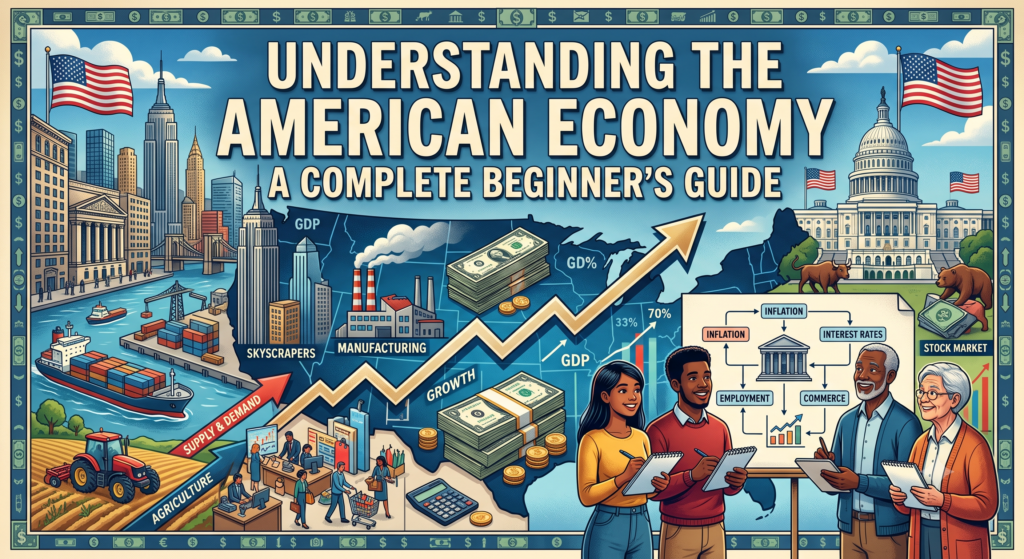
The economy of the United States is the largest national economy in the world, representing roughly a quarter of global gross domestic product (GDP). Whether you are an investor, a business professional, or simply someone looking to understand daily financial news, grasping how the U.S. economy functions is essential. From job markets and interest rates to grocery prices and stock indexes, economic forces shape almost every aspect of modern daily life.
This guide breaks down the fundamental mechanisms, key players, and primary indicators that drive the American economy into clear, actionable concepts.
1. The Core Engines of Economic Growth
At its foundation, an economy is a massive network of production, consumption, trade, and investment. The U.S. economy operates primarily as a mixed-market economy. While private enterprise and supply-and-demand dynamics dictate most economic activity, federal and state governments intervene through regulation, taxation, and public spending.
To measure the overall health and size of the U.S. economy, economists look at Gross Domestic Product (GDP). GDP measures the total monetary value of all finished goods and services produced within the country over a specific period.
The U.S. GDP is traditionally broken down into four main components:
$$\text{GDP} = C + I + G + (X – M)$$
| Component | Description | Share of U.S. Economy |
| Consumer Spending ($C$) | Personal expenditure on goods (cars, groceries) and services (healthcare, entertainment). | ~68–70% |
| Business Investment ($I$) | Corporate spending on equipment, technology, real estate, and inventory. | ~15–18% |
| Government Spending ($G$) | Expenditures on defense, infrastructure, public education, and government services. | ~17–19% |
| Net Exports ($X – M$) | Total exports ($X$) minus total imports ($M$). The U.S. consistently imports more than it exports, resulting in a net trade deficit. | Negative (~-3% to -5%) |
Because consumer spending accounts for nearly seven out of every ten dollars spent in the U.S., the American economic engine is exceptionally consumer-driven. When American households feel confident and spend freely, the economy expands; when consumers tighten their belts, growth slows significantly.
2. The Monetary System: The Federal Reserve’s Role
If money is the blood of the economy, the Federal Reserve (the “Fed”) is its heart. Serving as the central bank of the United States, the Fed operates independently of direct political influence to promote a healthy financial ecosystem.
The Fed’s Dual Mandate
Congress assigned the Federal Reserve two core objectives, known as its Dual Mandate:
- Maximum Employment: Fostering economic conditions where anyone who wants a job can find one.
- Price Stability: Keeping inflation low and predictable, officially targeting an average annual rate of 2%.
How the Fed Influences the Economy
The Fed primarily controls the economy by raising or lowering the Federal Funds Rate—the interest rate at which commercial banks lend reserves to each other overnight.
- Lowering Interest Rates: Makes borrowing cheaper for mortgages, credit cards, auto loans, and business investments. This stimulates economic activity during recessions but can lead to inflation if overdone.
- Raising Interest Rates: Increases borrowing costs across the system, cooling down consumer demand and business expansion. This is used to combat high inflation, though it carries the risk of triggering an economic slowdown or recession.
3. Fiscal Policy and the National Debt
While the Federal Reserve manages monetary policy (money supply and interest rates), the President and Congress manage fiscal policy (taxation and government spending).
Taxation and Federal Budgets
The U.S. government generates revenue primarily through individual income taxes, payroll taxes (funding Social Security and Medicare), and corporate income taxes. These funds are allocated toward two main categories of spending:
- Mandatory Spending: Programs required by law, including Social Security, Medicare, and veterans’ benefits.
- Discretionary Spending: Annual appropriations determined by Congress, with national defense making up the largest share, followed by education, transportation, and scientific research.
Deficits vs. National Debt
When federal spending exceeds annual tax revenues, the government operates at a budget deficit. To cover this gap, the U.S. Department of the Treasury issues financial securities, such as Treasury Bonds, Bills, and Notes. The cumulative total of all unpaid deficits over time constitutes the U.S. National Debt.
While high national debt carries long-term risks—such as rising interest costs for the government—U.S. Treasury debt remains widely regarded as one of the safest financial assets globally due to the creditworthiness and stability of the U.S. economy.
4. Key Economic Indicators Every Beginner Should Watch
Understanding economic trends does not require a advanced degree in finance; monitoring a few baseline metrics provides a clear picture of economic momentum.
- Consumer Price Index (CPI): Measures the average change over time in prices paid by urban consumers for a market basket of consumer goods and services. CPI serves as the primary gauge for measuring inflation.
- Nonfarm Payrolls & Unemployment Rate: Published monthly by the Bureau of Labor Statistics (BLS), this data reflects job creation numbers and the percentage of the labor force actively seeking employment.
- Consumer Sentiment Index: Gauges how optimistic or pessimistic consumers are regarding their personal finances and the general economy. High confidence usually leads to higher spending.
- Yield Curve: A graph showing the interest rates of Treasury bonds with varying maturity lengths. An “inverted yield curve”—where short-term debt pays higher interest than long-term debt—has historically served as a reliable warning signal for impending recessions.
5. How the U.S. Economy Impacts Global and Individual Wealth
Because the U.S. Dollar (USD) serves as the world’s primary reserve currency and the preferred medium for global commodities trading (such as crude oil), changes in American economic health ripple across the globe.
- Global Markets: When the U.S. economy expands, it increases demand for foreign imports, driving economic growth in manufacturing nations worldwide.
- Personal Finance: Domestically, federal interest rate decisions directly alter variable-rate debt, mortgage affordability, interest earnings on savings accounts, and stock market valuations.
Navigating the Financial Landscape
The American economy is a dynamic, evolving ecosystem balanced between private market innovation and public policy management. By paying attention to consumer spending, central bank decisions, labor market indicators, and fiscal trends, individuals and business owners can better anticipate market shifts, protect their financial assets, and make informed long-term investments.